



In today’s competitive labor market, speed and precision in hiring are no longer optional—they are strategic necessities. Organizations that identify, engage, and hire top talent faster often gain a measurable edge in productivity, innovation, and long-term growth. Recruitment platforms have evolved into sophisticated ecosystems that leverage automation, artificial intelligence, and data analytics to streamline hiring and dramatically reduce time-to-fill.
TLDR: Recruitment platforms help companies source, evaluate, and hire candidates faster through automation, AI-driven screening, and centralized workflows. The best tools reduce time-to-hire, improve candidate quality, and enhance collaboration between hiring teams. Choosing the right platform depends on company size, hiring volume, and recruiting complexity. Organizations that adopt modern recruitment technology gain a clear competitive hiring advantage.
Modern recruitment platforms are designed to address three major hiring challenges: attracting qualified candidates, filtering applications efficiently, and coordinating decision-making across teams. By integrating job postings, candidate tracking, communication tools, and analytics in one place, these platforms transform what was once a fragmented process into a streamlined operation.
Why Speed Matters in Talent Acquisition
The demand for skilled professionals often exceeds supply. High-performing candidates are typically on the job market for only a short time. A slow hiring process can result in:
- Loss of top candidates to faster competitors
- Increased vacancy costs
- Reduced team productivity
- Damage to employer brand perception
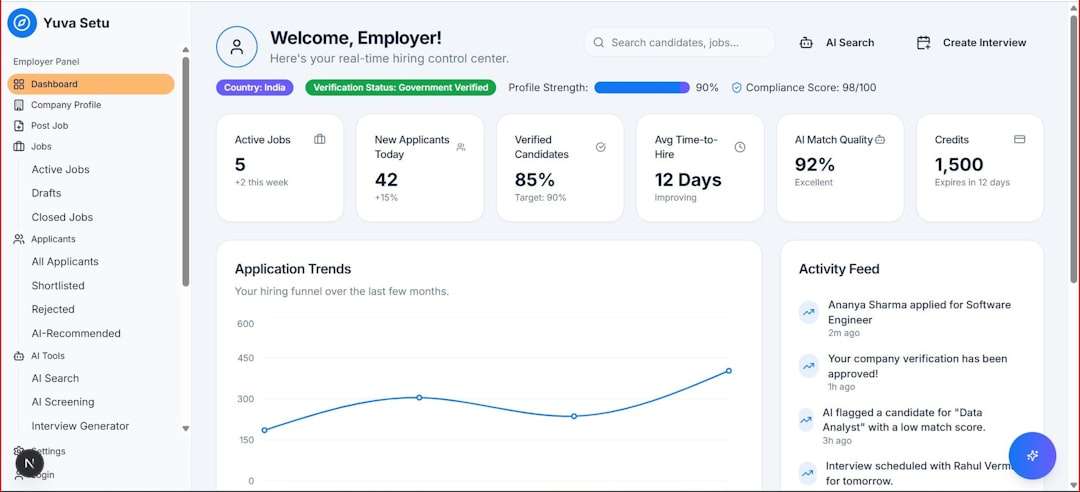
Recruitment platforms address these issues by automating repetitive tasks and providing real-time visibility into the hiring pipeline. This allows recruiters and hiring managers to focus on strategic decision-making rather than administrative work.
Core Features That Accelerate Hiring
Not all recruitment platforms are created equal. However, the most effective systems share several critical capabilities:
1. Applicant Tracking System (ATS)
An ATS forms the backbone of most recruitment platforms. It centralizes candidate data, tracks application status, and enables filtering by qualifications, experience, and other criteria. Advanced systems use AI to rank candidates based on job relevance.
2. AI-Powered Screening
Artificial intelligence can automatically analyze resumes, identify skill matches, and flag high-potential applicants. This reduces manual review time and improves consistency in candidate evaluation.
3. Multi-Channel Job Distribution
Leading platforms distribute job postings across multiple boards, social media channels, and professional networks with a single click. This ensures broader reach without multiplying administrative workload.
4. Automated Communication
Email sequences, interview scheduling links, and status notifications keep candidates informed and engaged. Automation reduces delays and enhances the candidate experience.
5. Analytics and Reporting
Data-driven insights help organizations monitor time-to-hire, cost-per-hire, source performance, and conversion rates. These metrics support continuous improvement of recruitment strategies.
Top Recruitment Platforms That Help Companies Hire Faster
Below are several widely adopted recruitment platforms known for accelerating hiring processes. Each serves different organizational needs.

1. Workday Recruiting
Designed for enterprise environments, Workday Recruiting integrates deeply with HR systems. It supports full-cycle recruiting, internal mobility, and workforce planning.
- Advanced analytics and reporting
- Strong enterprise integrations
- Global compliance features
Best for: Large organizations requiring end-to-end HR integration.
2. Greenhouse
Greenhouse focuses on structured hiring and data-driven decision-making. It emphasizes consistent interview processes and diversity-focused recruiting.
- Customizable interview scorecards
- Strong DEI support tools
- Robust reporting dashboard
Best for: Mid-sized to large companies prioritizing structured evaluation.
3. Lever
Lever combines applicant tracking with candidate relationship management (CRM). This makes it particularly effective for proactive talent nurturing.
- Integrated ATS and CRM
- Strong automation capabilities
- Pipeline management visibility
Best for: Organizations building long-term talent pipelines.
4. SmartRecruiters
SmartRecruiters offers a modern interface and extensive marketplace integrations. It is known for its ease of use and flexibility.
- Collaborative hiring workflows
- Extensive third-party integrations
- Global hiring support
Best for: Companies seeking scalability and usability.
5. iCIMS
iCIMS provides comprehensive talent acquisition capabilities, including onboarding and internal mobility tools.
- Scalable enterprise solution
- Advanced CRM functionality
- Strong compliance features
Best for: Enterprises with high-volume hiring demands.
Comparison Chart
| Platform | Best For | Key Strength | CRM Included | Enterprise Ready |
|---|---|---|---|---|
| Workday Recruiting | Large enterprises | HR system integration | Limited | Yes |
| Greenhouse | Data-driven teams | Structured interviewing | No | Yes |
| Lever | Pipeline recruiting | ATS + CRM combined | Yes | Yes |
| SmartRecruiters | Scalable organizations | Ease of use | Optional | Yes |
| iCIMS | High-volume hiring | Comprehensive TA suite | Yes | Yes |
How Recruitment Platforms Improve Candidate Quality
Speed should never compromise quality. The most advanced recruitment systems enhance candidate selection by:
- Standardizing evaluation processes to reduce bias
- Using predictive analytics to forecast performance potential
- Tracking passive candidates for future roles
- Encouraging structured interview feedback
By leveraging historical hiring data, platforms can identify patterns associated with successful employees. This allows companies to refine job descriptions, screening questions, and sourcing channels over time.
Reducing Time-to-Hire Through Automation
Manual processes are among the most significant contributors to slow hiring. Recruitment platforms introduce automation in several areas:
- Resume parsing to instantly categorize applicants
- Automated interview scheduling integrated with calendars
- Pre-screening questionnaires to filter unqualified applicants
- Offer letter generation with template customization
When these elements work in coordination, organizations often reduce time-to-hire by weeks rather than days.
Improving Collaboration Across Hiring Teams
Hiring decisions typically involve recruiters, hiring managers, department heads, and sometimes executives. Recruitment platforms centralize communication, ensuring that:
- Feedback is recorded in one location
- Interview notes are easily accessible
- Status updates are transparent
- Decision-making is data-supported
This level of visibility eliminates bottlenecks caused by email chains and disconnected spreadsheets.
Key Considerations When Choosing a Platform
While the benefits are clear, selecting the right recruitment platform requires careful evaluation. Decision-makers should assess:
- Company size and growth projections
- Integration requirements with existing HR software
- User adoption and interface usability
- Security and compliance standards
- Total cost of ownership
A thorough implementation plan—including training and change management—ensures the platform delivers measurable improvements.
The Strategic Advantage of Modern Recruitment Technology
Recruitment platforms are no longer simple applicant databases. They function as strategic talent acquisition engines that empower companies to compete effectively for skilled professionals. Organizations that invest in modern hiring technology frequently experience:
- Lower recruitment costs
- Better candidate experiences
- Higher retention rates
- More diverse hiring outcomes
In an environment where talent is often the differentiator between market leaders and followers, the ability to hire faster without sacrificing quality is invaluable.
Conclusion
Recruitment platforms have fundamentally transformed how companies find and hire top talent. Through automation, analytics, AI-powered screening, and collaborative workflows, these systems dramatically reduce time-to-hire while improving candidate quality. Whether serving a rapidly growing startup or a multinational enterprise, the right platform streamlines hiring operations and strengthens organizational competitiveness.
For companies committed to attracting exceptional talent, adopting a robust recruitment platform is not merely a technological upgrade—it is a strategic investment in long-term success.